How to Turn Early Users Into Product Advocates
Learn how to turn early users into product advocates through better onboarding, customer feedback, referrals, community building, and genuine user experiences.

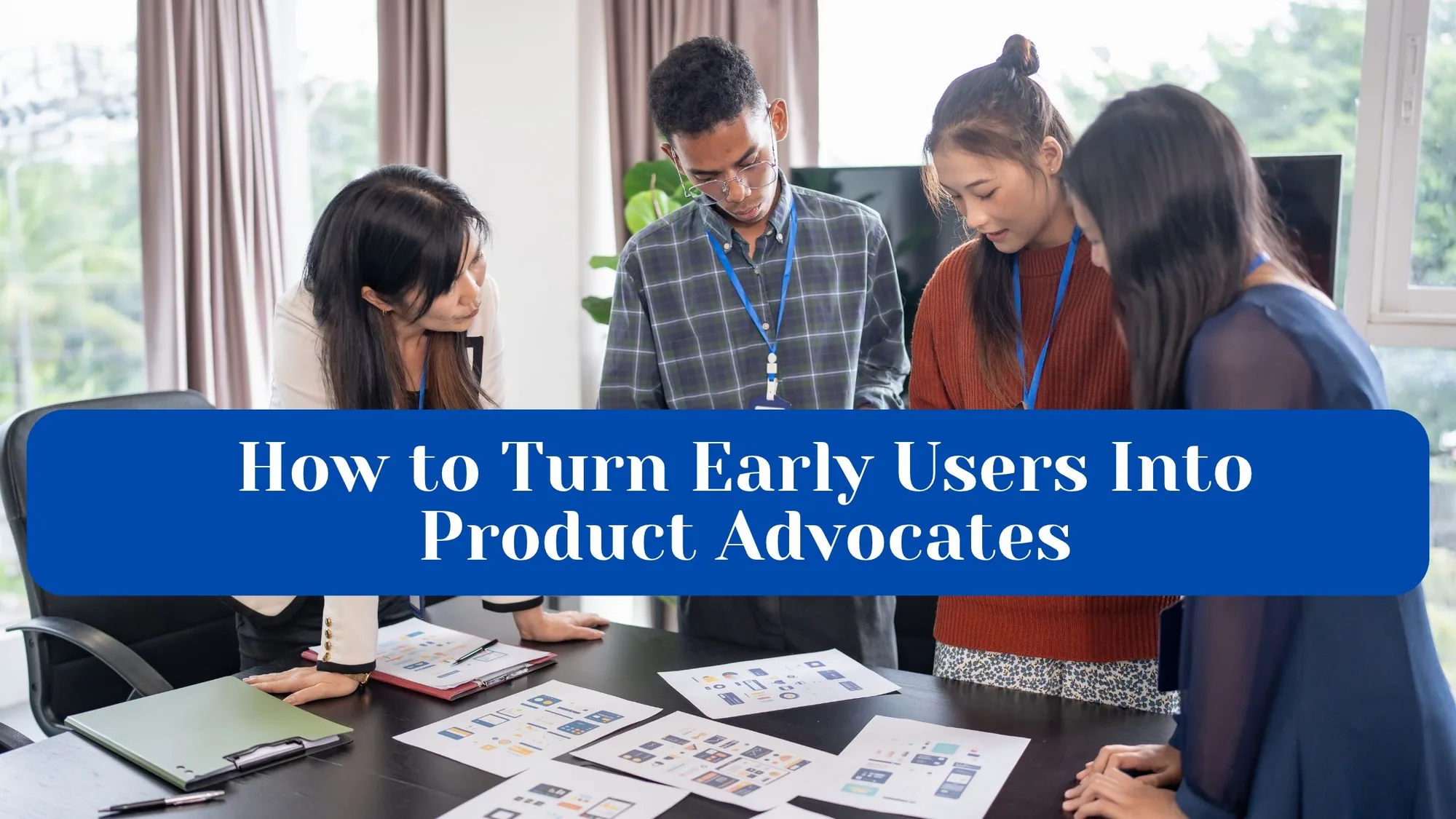
Your first users can do more than use your product. When they find genuine value in it, they may recommend it to colleagues, share their experiences online, introduce other customers, or become active members of your community.
But product advocacy rarely happens simply because someone creates an account or says they like your product. Users need a reason to trust it, a clear experience worth recommending, and an easy way to tell other people about it.
To turn early users into product advocates, help them achieve meaningful results, listen to their feedback, build relationships, and make it easy for them to share their experiences voluntarily. Start with a small group of engaged users rather than launching a referral campaign for everyone.
This approach is especially useful for early-stage startups and SaaS products that have limited marketing budgets but want to build sustainable customer acquisition channels.
In this guide, you'll learn how product advocacy works, how to identify potential advocates, when to ask for referrals, how to build a user community, and how to measure the results.
What Is Product Advocacy?
Product advocacy is when customers voluntarily recommend, support, or promote a product because they believe it provides value. Advocacy can happen through personal recommendations, online reviews, social media posts, referrals, case studies, community participation, or conversations with potential customers.
Product advocacy is closely related to word-of-mouth marketing, where people share information and experiences about products or services with others.
It is also related to customer retention and customer loyalty, although these concepts are different.
ConceptWhat it meansExampleCustomer satisfactionA user is pleased with an experienceA founder says your onboarding process was helpfulCustomer retentionA user continues using the productThe founder returns to your SaaS application each weekCustomer loyaltyA customer repeatedly chooses your productThe founder continues using your product despite alternativesProduct advocacyA user actively recommends or supports your productThe founder introduces two colleagues who need the same solutionReferral marketingA structured effort to encourage customer recommendationsYou provide customers with a referral link and track resulting signups
These concepts can overlap, but they should not be treated as interchangeable.
A satisfied user may never recommend your product. A loyal customer might prefer to keep the tool private. An advocate, by contrast, takes an action that helps other people discover or evaluate your product.
Your goal is not to make every customer promote your business. It is to create an experience that gives interested users a genuine reason to recommend it.
1. Help Users Experience Value Before Asking for Advocacy
The foundation of product advocacy is a product experience worth talking about.
If users cannot understand your product, struggle to complete their first task, or fail to achieve the outcome they expected, a referral request will probably arrive too early.
Start by identifying the moment when a new user first experiences meaningful value. Product teams often describe this as the activation moment.
For a project management application, activation might mean creating a project and assigning the first task. For an analytics product, it might mean viewing a useful report. For a writing tool, it could mean completing and exporting a document.
The exact activation event depends on the product.
How to improve the path to value
Step 1: Identify the main user goal.
What does the user want to accomplish when they sign up?
Avoid defining success only as creating an account. Account creation is a step, not necessarily evidence that the product solved a problem.
Step 2: Remove unnecessary obstacles.
Review the steps users must complete before they experience value. Look for confusing instructions, excessive setup requirements, missing examples, or workflows that require unnecessary effort.
Step 3: Show users what to do next.
A new user should understand the next useful action without needing to contact support.
Step 4: Confirm that the task was completed.
Use appropriate product events, user conversations, or task-based testing to determine whether people are reaching the intended outcome.
Step 5: Ask for feedback after the experience.
Once users have tried the core workflow, ask what helped them, what confused them, and what they would improve.
For more guidance, read ProdLaunchPad's article on how to find beta users for your startup. Early testers can help you identify the friction that prevents users from reaching value.
You can also explore the Wikipedia overview of customer development for background on learning from customers while developing a product.
Practical rule: Improve the experience before increasing the number of referral requests. Asking more people to recommend a confusing product will not fix the underlying problem.
2. Identify Users Who Are Most Likely to Become Advocates
Not every user will become an advocate, and that is normal.
Some users want a tool that quietly solves a problem. Others enjoy sharing discoveries, helping peers, participating in communities, or introducing useful products to their professional networks.
Your job is to recognize genuine engagement without assuming that every active user wants to promote your business.
Signals worth watching
Look for users who:
Return to the product and use it successfully.
Complete important workflows without repeated assistance.
Provide specific, constructive feedback.
Tell you how the product has helped with a real task.
Ask about upcoming improvements.
Participate in relevant discussions.
Voluntarily mention your product to other people.
Recommend the product without being prompted.
These signals are clues, not proof of advocacy.
For example, a user who logs in daily may rely on your product but have no interest in promoting it. Another user might log in less frequently but enthusiastically recommend it whenever a colleague faces the same problem.
Create a simple advocate-candidate list
You can start with a spreadsheet rather than a dedicated customer advocacy platform.
UserEvidence of engagementPossible next stepUser ACompleted the core workflow and shared detailed feedbackAsk whether they would join a product feedback sessionUser BRecommended the product to a colleagueThank them and ask whether the colleague needs assistanceUser CParticipates in product discussionsInvite them to a community or user groupUser DRepeatedly reports a blocking problemResolve the problem before asking for a recommendation
Do not use engagement scores as an excuse to bombard users with requests. Use the information to provide relevant support and identify people who may genuinely want a closer relationship with your product.
3. Ask for Feedback Before Asking for Referrals
Early users can help you improve the product long before they become advocates.
Feedback conversations reveal what users value, what prevents them from succeeding, and which parts of the experience deserve more attention.
They also give you an opportunity to demonstrate that the company listens.
A useful feedback process might include:
Ask users what they were trying to accomplish.
Find out whether they achieved their goal.
Identify confusing or frustrating steps.
Ask which improvement would make the product more useful.
Explain what you can do next.
Follow up when you make a relevant change.
For a deeper explanation, see the companion guide on how to get product feedback from early users. Before publishing this companion link, replace the general blog destination with the exact article URL if it is available on your site.
Close the feedback loop
Suppose a user tells you that your product's onboarding instructions are confusing.
A useful response is not simply, "Thanks for the feedback."
You might respond:
Thanks for explaining where you got stuck. We reviewed the onboarding flow and updated the instructions for that step. If you have a few minutes, we'd appreciate your thoughts on the revised experience.
This approach demonstrates that the user's time mattered.
It does not guarantee that the person will become an advocate. It does, however, create a better foundation for trust than repeatedly collecting suggestions without responding.
For a broader perspective on customer conversations, explore the Y Combinator Startup Library.
4. Make It Easy for Users to Recommend Your Product
Even enthusiastic customers may not recommend a product if they cannot explain what it does or where to send someone who might benefit from it.
Make sharing straightforward.
Give users a clear explanation of the product
A user should be able to explain three things:
Who the product is for.
What problem it solves.
Why someone might want to try it.
If your product description is vague, users may struggle to recommend it accurately.
For example, "an all-in-one productivity platform" tells a potential customer very little.
A more specific description could be:
"Our tool helps small agencies collect client approvals and keep project feedback in one place."
The second version gives people a clearer idea of who might benefit.
Provide useful sharing resources
Depending on your product, you could provide:
A short product description.
A direct link to the signup or product page.
A concise explanation of the main use case.
A demonstration video.
A practical guide that people can share.
A public changelog or roadmap.
A referral link, if a formal referral program makes sense.
Do not require users to copy marketing language that feels unnatural. Give them useful information and let them describe the product in their own words.
If your product is listed on ProdLaunchPad, make sure the listing clearly communicates its audience, purpose, and primary use case. You can start from the ProdLaunchPad homepage.
5. Ask for Recommendations at the Right Moment
Timing affects how a request is received.
An immediate request for referrals after signup may feel premature because the user has not yet experienced the product's value.
Instead, look for moments when the user has completed a meaningful task or voluntarily expressed satisfaction.
Potential moments include:
After successfully completing a core workflow.
After a user reports that a problem has been resolved.
After receiving positive feedback about a product improvement.
After a user shares a success story.
After someone voluntarily recommends your product.
The best moment depends on the product and the relationship.
Referral request example
Subject: Know someone who might find this useful?
Hi [Name],
Thanks for using [Product Name]. I'm glad you've had the opportunity to try it.
We're working to make the product more useful for people who face the same challenge. If you know a colleague or friend who might benefit from it, feel free to share this link: [Product Link].
There's no pressure. Your feedback and support are appreciated either way.
Thanks,
[Founder Name]
This message is direct, respectful, and easy to ignore if the user is not interested.
Avoid implying that users owe you a recommendation because they received free access, participated in a beta, or provided feedback.
What if the user says no?
Accept the answer.
Do not repeatedly ask, create artificial urgency, or imply that the user is letting the team down. Advocacy is most valuable when it reflects a genuine choice.
6. Build a Referral Program Only When It Fits
A referral program gives users a defined way to introduce other people to your product. Depending on the business, it may include referral links, tracking, rewards, or benefits for successful introductions.
But a referral program is not always the right starting point.
If users are still struggling with onboarding or do not understand the product's value, focus on fixing those problems first.
When a referral program may make sense
Consider a formal program when:
Users are already recommending the product organically.
You can clearly define a successful referral.
Your product has a suitable audience beyond your current users.
You can track referral outcomes reliably.
The economics support any incentives you offer.
Choose incentives carefully
Possible incentives include:
IncentivePotential useConsiderationExtended free accessProducts with a useful free tierMake the terms clearAccount creditsSubscription productsEnsure the credit is valuableAdditional featuresProducts with optional premium capabilitiesAvoid making core functionality unnecessarily restrictiveA donation to a relevant causeProducts with an appropriate charitable connectionExplain how the donation worksRecognitionCommunities or creator-focused productsObtain permission before public recognition
Cash rewards or discounts can motivate referrals, but they can also attract people who are more interested in the incentive than in the product.
Incentives should never require users to make false claims or misrepresent their experiences.
The Wikipedia article on word-of-mouth marketing provides additional background on how companies encourage product recommendations and why incentives need careful consideration.
Track meaningful outcomes
Do not measure a referral program only by the number of links shared.
Track:
Referral link visits.
Signups from referrals.
Activation among referred users.
Conversion to paid plans, where applicable.
Retention of referred users.
Cost of acquiring a referred customer.
A referral program that generates many signups but few active users may not be improving the business.
7. Build a Community Around the Problem You Solve
Some of the strongest product relationships develop when users can learn from one another rather than interacting only with the company.
A community might be a private group, public forum, discussion channel, user meetup, or online event.
The right format depends on whether users benefit from interacting with one another.
For example, a developer tool may benefit from a community where users share integrations and troubleshoot problems. A simple personal utility may not need a separate community at all.
How to start a small user community
Step 1: Identify a shared need.
What would users discuss even if your company were not present?
Step 2: Choose one channel.
Avoid creating multiple inactive groups. Start where your intended users are comfortable participating.
Step 3: Provide useful reasons to return.
You could share practical tutorials, invite users to discuss workflows, publish product updates, or host occasional feedback sessions.
Step 4: Encourage user-to-user assistance.
Let experienced users help others when appropriate. Recognize useful contributions without turning every discussion into a sales opportunity.
Step 5: Set clear expectations.
Explain the purpose of the community, how members should treat one another, and how the team handles feedback or support requests.
A community should provide value independently of promotional activity.
For startups still building their initial audience, read How to Build a Pre-Launch Audience for Your Product. The article explains how to create an engaged audience before launch and why meaningful participation matters more than a large but inactive following.
8. Encourage Reviews and Public Recommendations Ethically
Reviews can help potential customers understand how a product works and whether it fits their needs.
But reviews are only useful when people can trust them.
If you invite customers to leave a review, ask for an honest assessment rather than a positive rating.
A simple review request
Hi [Name],
Thanks for trying [Product Name].
We're collecting feedback to help people understand what the product does well and where it could improve. If you're comfortable sharing your experience, we'd appreciate an honest review here: [Review Link].
Please share what you genuinely think. Critical feedback is welcome too.
Thanks for your time.
Review practices to avoid
Do not:
Write reviews pretending to be customers.
Offer rewards in exchange for positive reviews.
Ask only satisfied customers to leave public reviews if doing so violates the platform's rules.
Hide material relationships or incentives.
Pressure users to change honest negative feedback.
Publish customer quotations without appropriate permission.
If you provide incentives for endorsements, check the applicable platform policies and advertising disclosure requirements. For US-facing campaigns, the Federal Trade Commission's endorsement guidance is a useful starting point. Other jurisdictions may impose different obligations.
The objective is credible feedback, not a manufactured reputation.
9. Turn User Success Stories Into Useful Content
With a user's permission, a genuine experience can help other people understand what your product does.
A success story might describe how a customer approached a problem, what they used the product for, what worked, and what limitations they encountered.
Useful formats include:
Customer interviews.
Case studies.
Product walkthroughs.
Short video testimonials.
Public user stories.
Before-and-after workflow comparisons.
Educational articles based on a customer's use case.
Do not invent customer results or exaggerate what a product achieved.
If you do not have enough evidence for a full case study, publish a more modest piece of content, such as a walkthrough of a common workflow or a guide to solving a relevant problem.
A simple case study structure
Context: Who is the user, and what were they trying to accomplish?
Problem: What difficulty did they face?
Approach: How did they use the product?
Outcome: What changed, based on evidence the user can support?
Limitations: What did the product not solve?
Lesson: What might another user learn from this experience?
This structure gives potential customers more useful information than a generic statement such as "This is a great product."
For product discovery and launch-related content, ProdLaunchPad can also serve as a place to connect readers with products that address the problems discussed in your articles. Keep those references relevant and avoid presenting promotional claims as independent customer evidence.
10. Measure Product Advocacy Without Overcomplicating It
You do not need an elaborate advocacy dashboard when you have only a small number of users.
Start by measuring a few outcomes that connect advocacy to real customer behavior.
MetricWhat it tells youImportant limitationReferral visitsHow often people follow referral linksVisits do not prove interest or conversionReferred signupsHow many new accounts came through referralsSignups may never become active usersReferred-user activationWhether referred users reach a meaningful milestoneActivation depends on how the product is definedReferral conversionHow many referred users become customersResults vary by audience and acquisition channelReferral retentionWhether referred users continue using the productRetention needs a suitable time windowOrganic recommendationsWhether users mention the product without a formal referral requestSome recommendations will be difficult to attributeUser participationWhether customers contribute to discussions or feedbackParticipation does not always mean commercial advocacy
Start with a basic measurement process
Define what counts as a referral.
Track the source of referred signups where possible.
Define the activation event that represents meaningful product use.
Compare referred-user behavior with other acquisition channels.
Review retention after an appropriate period.
Ask users how they discovered the product when attribution is unclear.
Avoid assuming that every referral resulted from a single campaign. People may discover a product through a colleague, then search for it independently or encounter it through another channel.
Use attribution as a helpful estimate rather than a perfect record of how every customer discovered your business.
11. A Practical 30-Day Plan to Develop Product Advocates
Here is a manageable plan for a small startup.
PeriodActionIntended outcomeDays 1–5Identify the product's main value moment and review onboardingUnderstand what users must experience before recommending the productDays 6–10Speak with engaged users and collect feedbackIdentify what users value and what still causes frictionDays 11–15Fix one or two important problemsImprove the experience before asking for advocacyDays 16–20Follow up with users who contributed feedbackClose the feedback loop and check whether the change helpedDays 21–25Invite interested users to share feedback, participate in a community, or recommend the productMake voluntary participation easierDays 26–30Review referrals, user engagement, and feedbackDecide what to continue, change, or stop
This is a suggested workflow, not a guarantee of growth. The number of users, product complexity, and speed of implementation will affect the results.
If you are still acquiring your initial users, start with How to Get Your First 10 Users. If you are preparing for a launch, also read How to Build a Pre-Launch Audience.
These activities work together: acquiring users creates opportunities to learn, feedback improves the product, and a better experience may create reasons for users to recommend it.
Common Mistakes That Prevent Product Advocacy
Asking for referrals too early
A new signup is not necessarily an engaged user. Give people time to experience the product before making a referral request.
Assuming every satisfied customer will promote you
Some people prefer to use products privately. Respect that preference instead of treating advocacy as an obligation.
Using incentives to compensate for a weak product
Rewards cannot reliably overcome poor usability, missing value, or a lack of trust. Improve the product experience first.
Making referral requests too complicated
If users need to understand a lengthy process or write their own promotional material, fewer may participate. Provide a simple link and a clear explanation.
Ignoring negative feedback
Users who report problems may be pointing to issues that also affect others. Investigate the underlying cause before focusing on promotion.
Treating community members as a marketing channel
A community loses value when every conversation becomes a sales pitch. Help members solve problems and learn from one another.
Measuring activity instead of outcomes
The number of posts, reviews, or referral links is not the same as business impact. Track meaningful product use and customer outcomes alongside advocacy activity.
Frequently Asked Questions
How do you turn early users into product advocates?
Help early users achieve value, listen to their feedback, address important problems, and build a trustworthy relationship. Once users have a positive experience, make it easy for those who are willing to recommend the product to share a link, leave an honest review, or introduce someone who may benefit.
What is the difference between a product advocate and a brand ambassador?
A product advocate may voluntarily recommend a product because of their experience. A brand ambassador is often formally appointed, paid, or otherwise engaged to represent an organization. The terms can overlap, but they are not identical. A startup should be clear about whether a recommendation is voluntary or part of a paid relationship.
When should a startup ask users for referrals?
Ask after users have experienced meaningful value or expressed genuine satisfaction. Avoid requesting referrals immediately after signup if the user has not yet used the product. The right moment depends on the product and the user's journey.
Do product advocates need to receive rewards?
No. Some people recommend products because they find them useful or want to help others with the same problem. Rewards may be appropriate for a formal referral program, but incentives should be transparent and should not require dishonest endorsements.
How can a startup find its first product advocates?
Start by talking to active users, reviewing feedback, and identifying people who have successfully used the product or voluntarily recommended it. Ask whether they would like to participate in a feedback session, community, case study, or referral program. Let users choose how they want to participate.
How can you measure customer advocacy?
Track referrals, referred-user activation, customer retention, voluntary recommendations, and community contributions. No single metric captures all advocacy, so combine behavioral data with direct conversations and feedback.
Can product advocacy work for a SaaS startup with no marketing budget?
Yes. A startup can begin by improving onboarding, helping users succeed, asking for honest feedback, and making recommendations easy. These activities require time and consistent follow-up rather than a large advertising budget. They do not guarantee referrals, but they help create the conditions in which recommendations may occur.
How does product advocacy support startup growth?
Recommendations can introduce a product to people who already trust the person sharing it. Referred users may arrive with useful context about the product, although their conversion and retention still depend on whether it meets their needs. Advocacy works best as part of a broader strategy that includes product quality, customer support, and user retention.
Conclusion: Build Advocacy by Giving Users a Reason to Recommend You
Product advocacy starts with the user's experience, not the referral link.
Help people achieve their goals. Listen when they describe problems. Make meaningful improvements. Communicate honestly, and provide a simple way for interested users to share what they genuinely think.
A practical starting point is to identify five engaged users, speak with them about their experience, resolve one recurring problem, and follow up to learn whether the change helped.
Some may become advocates. Others may simply continue using the product. Both outcomes can be valuable.
The goal is not to turn every customer into a marketer. It is to build a product and relationship that people feel comfortable recommending when it is genuinely useful to someone else.
Continue exploring ProdLaunchPad's guides on getting your first 10 users, finding beta users, and building a pre-launch audience.
Enjoyed this article? Share it.
Written by
Smith Adams
Smith Adams is a product researcher and content writer at ProdLaunchPad, covering SaaS, AI tools, product launches, startup growth, and product discovery. He writes practical, research-driven articles to help founders, makers, and entrepreneurs discover useful tools, make informe
Comments (0)
No comments yet
Start the conversation.